Brick, Block and Stone: What Changes Between Them?
Compare brick, block, and stone by scale, texture, and joints to read a masonry wall’s visible character without mistaking its surface for the full assembly.
The common mistake is to treat brick, concrete block, and natural stone as interchangeable wall finishes. Choosing by appearance alone can obscure what the wall actually shows: each material has a different scale, texture, and pattern of joints. Brick, block, and stone can all form masonry, but their visible units are not alike.
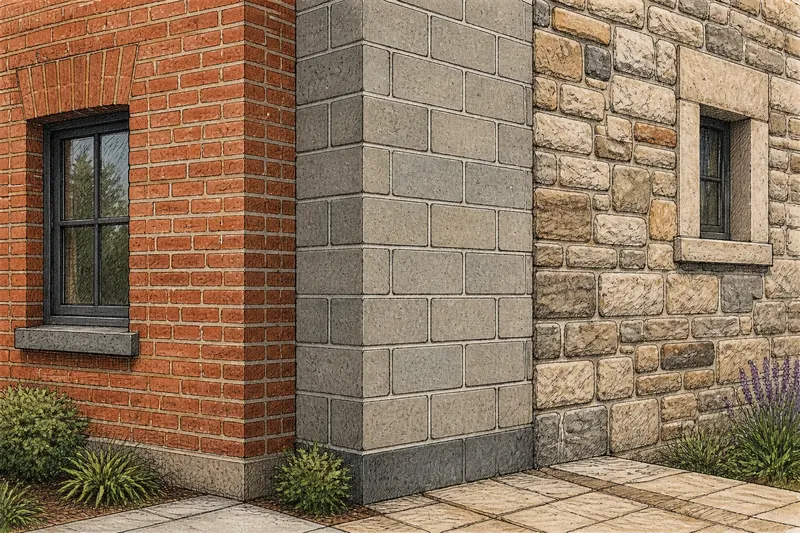
Brick, block, and stone are easiest to distinguish by looking at the unit and the rhythm it creates. Brick usually reads as a fine, repeated pattern; concrete block makes a broader module visible; natural stone often displays variation in shape, color, and surface. Those impressions come from the material’s form as much as from its color.
Brick creates a fine, repeated pattern
A brick wall is built from relatively small, regularly shaped units. Their horizontal rows, called courses, create a close pattern. Mortar joints remain visible, but the small units often make the wall read as a continuous field rather than a collection of large blocks.
That fine grain can define edges and openings. A change in bond—the arrangement of bricks from course to course—can give a corner purpose or add direction to a broad surface. Bricks set on end, called soldier courses, can mark a lintel line or frame a window. Running bond, in which vertical joints are offset between rows, gives a wall a steady horizontal cadence.
Brick’s character also depends on its surface and mortar. Clay bricks may be smooth or heavily textured, and their color can be consistent or varied. A recessed mortar joint creates shadow around the brick edges; a flush joint makes the surface look more continuous.
Brick can be the exposed face of a wall backed by another material, or it can be part of the wall’s main construction. The visible surface alone does not tell you which arrangement is present. Notice whether the brick is an exterior face, an interior finish, or an exposed part of the construction.
Look at the mortar as carefully as the brick.
Concrete block makes the unit size clear
Concrete masonry units, often called concrete blocks or CMUs, are larger than familiar face bricks. Fewer units and joints appear across a similar surface, so the wall’s modular structure is more apparent. Broad faces, regular courses, and repeating vertical joints give it a direct rhythm.
Many concrete blocks have hollow cores, though solid units and blocks designed for particular finishes are also common. The cores are part of the unit’s construction, not a decorative feature on the finished face. Depending on the wall design, reinforcement or grout may be placed within the masonry. A view of the surface cannot establish what is inside.
Block’s visual character often comes from its surface treatment. Standard units may be left exposed in service spaces or covered with another material. Architectural concrete masonry can have split, ground, or otherwise textured faces. Even when carefully finished, the larger module remains visible.
Block is not simply rough where brick is fine. A well-composed block wall can look orderly and substantial, while brick can be plain or visually busy. The difference is chiefly in unit scale: block joints sit farther apart, so a change in alignment or a cut unit is often more noticeable.
Notice where the unit size sets the rhythm and where a finish changes what remains visible.
Natural stone makes variation part of the surface
Natural stone is quarried, then shaped or selected for a wall. Its color and texture depend on the stone, while its final appearance reflects how the pieces are cut, split, dressed, and arranged. Unlike manufactured brick and block, stone often varies visibly from piece to piece.
That variation can be restrained or pronounced. Ashlar masonry uses carefully shaped stones in relatively even courses, creating a regular surface. Rubble masonry uses less uniform pieces, so the outlines and joints vary more. Stone can also be cut into consistent rectangles, split into irregular faces, or applied as a thin facing over another wall construction.
A stone wall’s visual weight is not only a matter of color. Rough faces catch light differently from sawn or polished ones. Irregular joints make the surface more articulated, while closely fitted stones create a more continuous impression. The size and arrangement of the pieces determine whether the eye reads a pattern, individual stones, or a broad textured plane.
“Stone wall” does not identify one construction method. It may refer to solid masonry, a facing, or a veneer supported by another structure. Nor does a stone-like appearance prove that the material is natural stone; manufactured products can imitate its color and texture. An exposed edge or cut surface may offer a clue, but product information is more reliable for identifying a material.
With stone, the joint pattern is part of the wall’s character, not merely the gap between pieces.
Joints show how masonry units relate
Mortar joins masonry units and makes their arrangement readable. In brickwork, many narrow joints emphasize the course pattern. In blockwork, fewer, larger units give each joint a more noticeable place in the grid. In stonework, joint widths and shapes may vary with the pieces or remain regular through careful cutting and laying.
Bond describes how units overlap or align across courses. Running bond offsets vertical joints from one row to the next; stack bond aligns them in continuous vertical lines. These patterns affect a wall’s visual order, but they do not fully explain how it is supported or reinforced. That depends on the wall assembly, not just the visible layout.
Joint treatment also changes the apparent depth of a wall. A recessed mortar joint casts a shadow around each unit, while a joint finished close to the face softens that outline. In stone, a deeply shaped joint can accentuate irregular edges; in brick, it can sharpen the grid.
Say you are comparing two sample panels made from the same brick. The starting inputs are identical bricks and the same bond; one panel has recessed joints, while the other has flush joints. You look at both from nearby and farther away. The recessed panel appears more patterned, while the flush panel reads more like a continuous brick-colored surface. The comparison shows how mortar changes the face, but it does not identify the wall behind either panel.
What do brick, block, and stone reveal?
Why does brick look more finely grained?
Brick units are smaller than typical concrete blocks and are usually laid in closely spaced courses. The eye catches many units and mortar joints rather than a few broad modules.
Why can concrete block look utilitarian?
Its broad faces and regular joints make the construction module easy to see, especially when the units are exposed. Texture, color, and finishing can soften that impression without changing the unit scale.
Why does natural stone vary from wall to wall?
Natural stone differs by source and by how pieces are cut, split, selected, and laid. Carefully dressed stone can look orderly, while irregular pieces make variation a stronger feature.
Can the visible face identify the whole wall assembly?
Not reliably: brick or stone may be a facing over another construction, and a block wall may contain reinforcement or grout that is not visible. The surface reveals its pattern and finish, not every layer behind it.
Surface appearance does not settle the construction question
A visible material is only one part of a wall assembly. The same brick face might sit in front of a different backup wall in one building and form part of a more substantial masonry wall in another. Stone can be a thin facing or larger masonry units. Concrete block may be exposed, concealed, or finished with another surface.
For that reason, do not infer a wall’s full role from a photograph or a street-side view. Look for an exposed edge at a return, a window opening, or another place where thickness and layers can be seen. Treat what is visible as a clue, not a complete specification. If the assembly matters for a project, consult the building plans or a qualified construction professional.
Labels and trade language can shift with context. “Brick” may refer to a material, a visible facing, or a familiar appearance. “Stone” may describe natural stone or a manufactured imitation. Product labeling, manufacturer instructions, and local requirements govern specific identification and use.
Read masonry by scale, texture, and joints
When you encounter a masonry surface, start with the unit: is it small and regular, broad and modular, or varied in shape and source? Then examine the joints, bond, and face finish. These observations will not reveal everything about construction, but they help separate visible character from assumptions about what lies behind it.
Brick draws attention to a fine repeating pattern; block presents its module clearly; stone lets individual pieces contribute more variation. Comparing brick, block, and stone is not about ranking them. It is a way to recognize what the wall’s visible materials can—and cannot—tell you.
A joint, a cut edge, or a change in unit scale can be more informative than a broad label on its own. Use those clues to describe the visible surface, and seek plans or professional guidance before treating them as a full account of the wall.